[8:49 PM, 1/12/2026] +509 46 33 8632:
I. Introduction — Le XXIᵉ siècle ou la fin des illusions globales.-
Le XXIᵉ siècle se caractérise par une mutation profonde des équilibres mondiaux. La mondialisation, longtemps perçue comme un vecteur universel de prospérité et de démocratie, a révélé ses limites: dépendance économique, fragilité des institutions nationales, inégalités croissantes et perte de confiance dans les élites. Le progressisme globaliste, souvent déconnecté des réalités locales, a échoué à fournir des solutions durables aux crises économiques, sociales et sécuritaires.
Dans ce contexte, la Nouvelle Amérique de Donald Trump inaugure une ère post-idéologique, centrée sur le réalisme, la souveraineté et l’efficacité. Sa politique étrangère n’est plus fondée sur des slogans abstraits ou des promesses idéologiques, mais sur la capacité à obtenir des résultats tangibles pour son peuple et à préserver l’influence américaine sur la scène mondiale. Trump a ainsi redéfini la notion même de puissance : elle ne réside plus seulement dans la projection militaire ou la diplomatie traditionnelle, mais dans la combinaison du pragmatisme économique, de la fermeté stratégique et de la crédibilité politique.
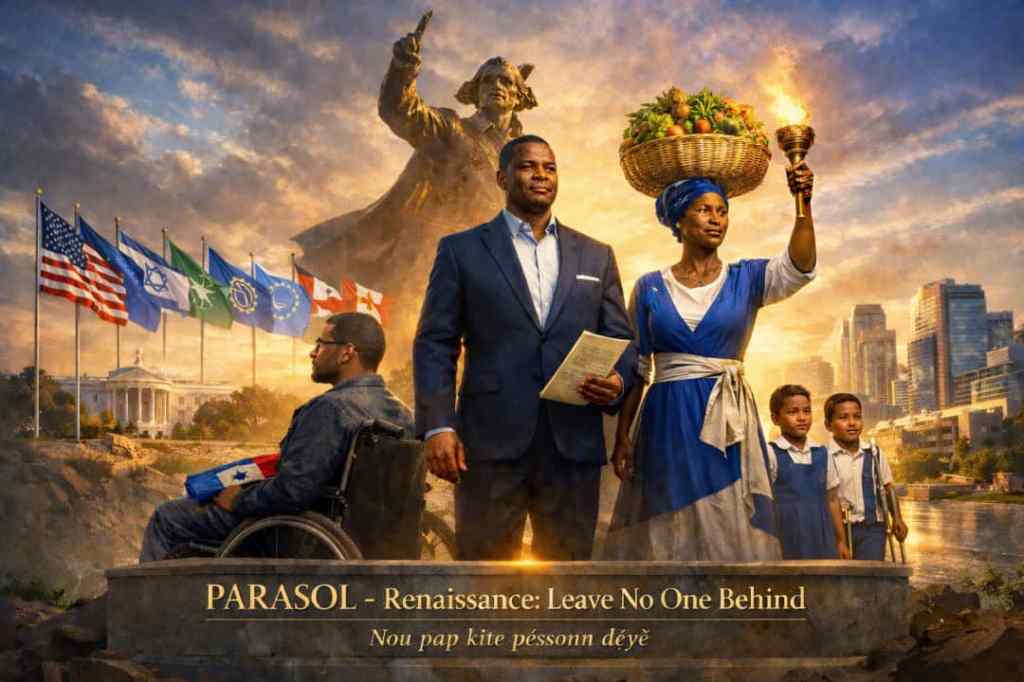
Haïti, confrontée à une instabilité chronique et à un effondrement institutionnel, se retrouve à la croisée des chemins. Dans ce contexte mondial, le pays a besoin d’une vision qui combine discipline, rationalité et humanisme, capable de restaurer sa souveraineté et de répondre aux aspirations de sa population. La Renaissance Dessalinienne proposée par Yvon Bonhomme et le PARASOL, à travers le programme Renaissance (Leave No One Behind), représente cette alternative. Elle articule une approche holistique, incluant la reconstruction économique, la justice sociale et l’inclusion des femmes, des jeunes et des personnes handicapées, tout en préservant la souveraineté nationale.
Cette tribune analyse le phénomène de la nouvelle droite mondiale, compare ses succès aux échecs des régimes populistes de gauche, et démontre comment la vision de Bonhomme s’inscrit comme une solution réaliste et humaniste pour Haïti, en harmonie avec les nouvelles orientations internationales, notamment celles portées par Donald Trump et ses alliés.
II. La Nouvelle Amérique de Donald Trump — Le retour du réalisme politique global.-
Donald Trump incarne un tournant décisif dans l’histoire contemporaine. Sa présidence a été marquée par une remise en question du multilatéralisme et un retour à un réalisme politique assumé. La doctrine Trumpienne repose sur plusieurs piliers:
- Souveraineté nationale avant tout: Les États-Unis ont réaffirmé leur primauté sur la définition de leur politique intérieure et extérieure, rompant avec les attentes globalistes.
- Puissance économique comme instrument de diplomatie: L’imposition de tarifs douaniers et la renégociation des accords commerciaux internationaux ont montré que la force économique pouvait protéger l’industrie nationale et rétablir un équilibre global. Sécurité nationale et ordre moral : Les réformes militaires et les initiatives contre le terrorisme ont été guidées par une vision pragmatique, centrée sur la protection des citoyens et de leurs intérêts stratégiques.
- Alliances transactionnelles et équilibrées: Trump a privilégié la collaboration pragmatique avec des partenaires fiables (Israël, certains pays du Golfe), tout en maintenant une posture ferme face aux puissances qui ne respectaient pas les intérêts américains.
Cette approche a inspiré et légitimé un mouvement mondial de droite réaliste et humaniste, où l’efficacité prime sur l’idéologie, et où la souveraineté est un principe fondamental.
III. L’effondrement du populisme de gauche en Amérique latine…
[8:49 PM, 1/12/2026] +509 46 33 8632: The New America of Donald Trump and the Dessalinian Renaissance: Haiti in the Reconfiguration of Global Power.-
I. Introduction — The 21st Century and the End of Global Illusions.-
The 21st century is marked by profound shifts in global power structures. Globalization, long seen as a universal driver of prosperity and democracy, has revealed its limits: economic dependency, institutional fragility, rising inequalities, and a loss of trust in elites. Globalist progressivism, often disconnected from local realities, has failed to deliver sustainable solutions to economic, social, and security crises.
In this context, Donald Trump’s New America inaugurates a post-ideological era, centered on realism, sovereignty, and efficiency. U.S. foreign policy is no longer guided by abstract slogans or ideological promises but by the ability to deliver tangible results for the American people and maintain influence on the world stage. Trump has thus redefined the very notion of power: it lies not only in military projection or traditional diplomacy but in the combination of economic pragmatism, strategic firmness, and political credibility.
Haiti, facing chronic instability and institutional collapse, stands at a crossroads. In this global context, the country requires a vision that combines discipline, rationality, and humanism, capable of restoring sovereignty and addressing citizens’ aspirations. The Dessalinian Renaissance proposed by Yvon Bonhomme and PARASOL, through the program Renaissance (Leave No One Behind), represents this alternative. It articulates a holistic approach, including economic reconstruction, social justice, and inclusion of women, youth, and persons with disabilities, while preserving national sovereignty.
This article analyzes the phenomenon of the global new right, compares its successes to the failures of leftist populist regimes, and demonstrates how Bonhomme’s vision constitutes a realistic and humanist solution for Haiti, aligned with the new international orientations led by Donald Trump and his allies.
II. Donald Trump’s New America — The Return of Global Political Realism.-
Donald Trump represents a decisive turning point in contemporary history. His presidency was marked by a questioning of multilateralism and a return to unapologetic political realism. The Trump doctrine is based on several pillars:
- Primacy of national sovereignty: The United States reaffirmed its leadership in defining domestic and foreign policy, breaking from globalist expectations.
- Economic power as a diplomatic instrument: Imposition of tariffs and renegotiation of trade deals demonstrated that economic strength could protect domestic industry and restore global balance.
- National security and moral order: Military reforms and anti-terrorism initiatives were guided by pragmatism, focused on protecting citizens and strategic interests.
- Transactional and balanced alliances: Trump prioritized pragmatic cooperation with reliable partners (Israel, certain Gulf states), while maintaining firmness toward powers that did not respect American interests.
This approach inspired and legitimized a global movement of realistic and humanist right-wing politics, where efficiency takes precedence over ideology, and sovereignty is a fundamental principle.
III. The Collapse of Leftist Populism in Latin America.-
Latin American leftism, from Hugo Chávez to Nicolás Maduro in Venezuela, Evo Morales in Bolivia, and Daniel Ortega in Nicaragua, relied on anti-imperialist rhetoric and promises of wealth redistribution. However, the realities of the 21st century have revealed their limitations: economic failure, institutional weakening, social crisis, and diplomatic marginalization. The rise of pragmatic right-wing leaders, exemplified by Trump, Meloni, Milei, and Bukele, represents the necessary corrective to ideological failures.
IV. The Case of Maduro — Idealism Versus Reason.-
Nicolás Maduro exemplifies the failure of leftist populism: hyperinflation, shortages, mass exodus, and authoritarian centralization of power. Unlike Trump and other realistic leaders, Maduro clings to power through coercion rather than reform, demonstrating the moral bankruptcy of populism. The lesson is clear: in the 21st century, governance requires pragmatism and rationality.
V. The Rise of the Global New Right.-
The contemporary world is witnessing a major ideological shift. Pragmatic and realistic right-wing leaders, including Donald Trump (USA), Giorgia Meloni (Italy), Javier Milei (Argentina), Nayib Bukele (El Salvador), Benjamin Netanyahu (Israel), Viktor Orbán (Hungary), Marine Le Pen (France), Geert Wilders (Netherlands), Narendra Modi (India), William Ruto (Kenya), and Bola Tinubu (Nigeria), embody a movement founded on realism, sovereignty, and political efficiency. Common traits include national sovereignty, economic pragmatism, security and public order, and rational, inclusive nationalism. This rise redefines international alliances and offers a model that Haiti can adopt through the Dessalinian Renaissance.
VI. Haiti at the Crossroads of Sovereignties: From Chaos to the Dessalinian Renaissance.-
Haiti, facing institutional collapse and external dependency, can leverage global transformations. The Dessalinian Renaissance and the program Renaissance (Leave No One Behind) aim to restore the moral authority of the state, rehabilitate key institutions, develop an inclusive economy, and ensure the integration of all social groups. This holistic approach combines discipline, rationality, and humanism.
VII. The Humanist Dessalinian Right — Haiti’s Response to Global Shifts.-
The Humanist Dessalinian Right combines strong national sovereignty, enlightened authority, and practical humanism. The 13 Commandments of the Second Republic guide governance, economic development, education, and diplomacy. This approach reflects the principles of the New America while adapting them to Haitian realities, offering stability, social cohesion, and international credibility.
VIII. Yvon Bonhomme — The Stoic Leader of Haiti’s New Governance.-
Yvon Bonhomme embodies the convergence of historical vision and contemporary pragmatism. Former DG of MHAVE and founder of the Madan Sara movement, he applies political stoicism, Dessalinian humanism, and strategic diplomacy. His inclusive and effective vision constitutes a credible alternative for Haiti’s challenges.
IX. Diplomacy and Partnership with the New America.-
Haiti can benefit from the rise of the New America to strengthen its international position through pragmatic cooperation with the USA, balanced dialogue with Israel and the BRICS, and integration into regional security and development initiatives. The PARASOL program ensures Haiti cooperates without subservience, maintaining autonomy and respect.
X. Conclusion — The World, Haiti, and the Renaissance of the Real.-
The 21st century demands realism and responsibility. The rise of pragmatic right-wing leadership demonstrates that sovereignty, discipline, and rationality are pillars of modern power. Haiti can reposition itself as a credible actor through the Dessalinian Renaissance and the PARASOL program. Yvon Bonhomme embodies moral and rational leadership, combining sovereignty, humanism, and governmental efficiency.
Annexes and References:
- Firstpost (2025), Rise of Right-Wing Politics: A Global Trend.
- Foreign Affairs (2025), The Triumph of Realism: Trump’s Second Era of Sovereignty Le Monde Diplomatique (2024), Meloni and European Conservatism
- The Economist (2024), Javier Milei and the New Libertarian World.
- Brookings Institution (2025), Authoritarian Populism in Latin America: From Chavismo to Bukelism.
- Harvard Kennedy Review (2024), Geopolitical Realignment of the 21st Century.
- Official PARASOL Dossier (2025), Dessalinian Humanist Doctrine and Haiti’s Renaissance.
- El País (2023), The Venezuelan Paradox and the Collapse of Chavismo.
Signed:
Yvon Bonhomme
Founder and President of the Patriotic Rally for Saving the Homeland (PARASOL),
Stoic Philosopher, Engaged Researcher,
Former Director General of the Ministry of Haitians Living Abroad (MHAVE),
Designer of the New Dessalinian Right Doctrine,
Architect of the Second Republic of Haiti,
Initiator and Designer of the Madan Sara Movement,
Author of Renaissance (Leave No One Behind).
Email:yvonbonhommeh@gmail.com.
 Global Innovation for Humanity 77X7 (safepathusa)
Leave a comment